european rye bread; a tuesdays with dorie post

IMG_2470

Rye bread is one of those things people either love or hate.  In my opinion, I think it is more likely related to whether or not you like caraway seeds.  Most of it would probably be better off labeled caraway bread since the distinct flavor of the seeds is all you can taste in commercially prepared rye bread.  However, as a lover of toast, rye bread, loaded with caraway and slathered in salted butter, is one of my favorite breakfasts.

This week, the Tuesdays with Dorie bakers are sharing their experiences with European Rye Bread from Baking with Julia.  If you recall, we made a similar recipe from the book, Pumpernickel loaves, a while back.  Both recipes were contributed by Lauren Groveman and they each call for the unusual step of hanging the loaf in a sling for the final rise of the shaped loaf.

IMG_2874The bread is fairly easy to mix and since it is a rye bread, the ingredient list is simple.  The only confusing part about it, finding the proper rye flour.  Allow me to wish you well with this endeavor.  Every rye bread recipe I read calls for a specific type of rye flour and not all millers produce them equally.  Essentially, the amount of whole grain used in the flour is the difference and if you would like a better understanding of what each type of rye flour is, this chart from the Whole Grains Council may help you understand it all.   While the chart does explain things, they also make it a point to mention, repeatedly, that not all millers produce equal products; the chart is more of a suggestion than a standard.  As for my bread, I have only been able to find Hodgson Mill 100% stone ground rye flour which according to the chart makes it a dark rye flour.

IMG_2451The whole grain flour gives the dough a lot of texture and it also makes it a bit denser than I like.  Working with a half batch of dough, I made just one loaf and I stuck to the recipe pretty closely.  Bread baking is not really my strong point and I really wanted to make a loaf as described by the head note of the recipe, with a brittle crust that snaps into small flakes and a soft, slightly moist and a little springy inside.
IMG_2455

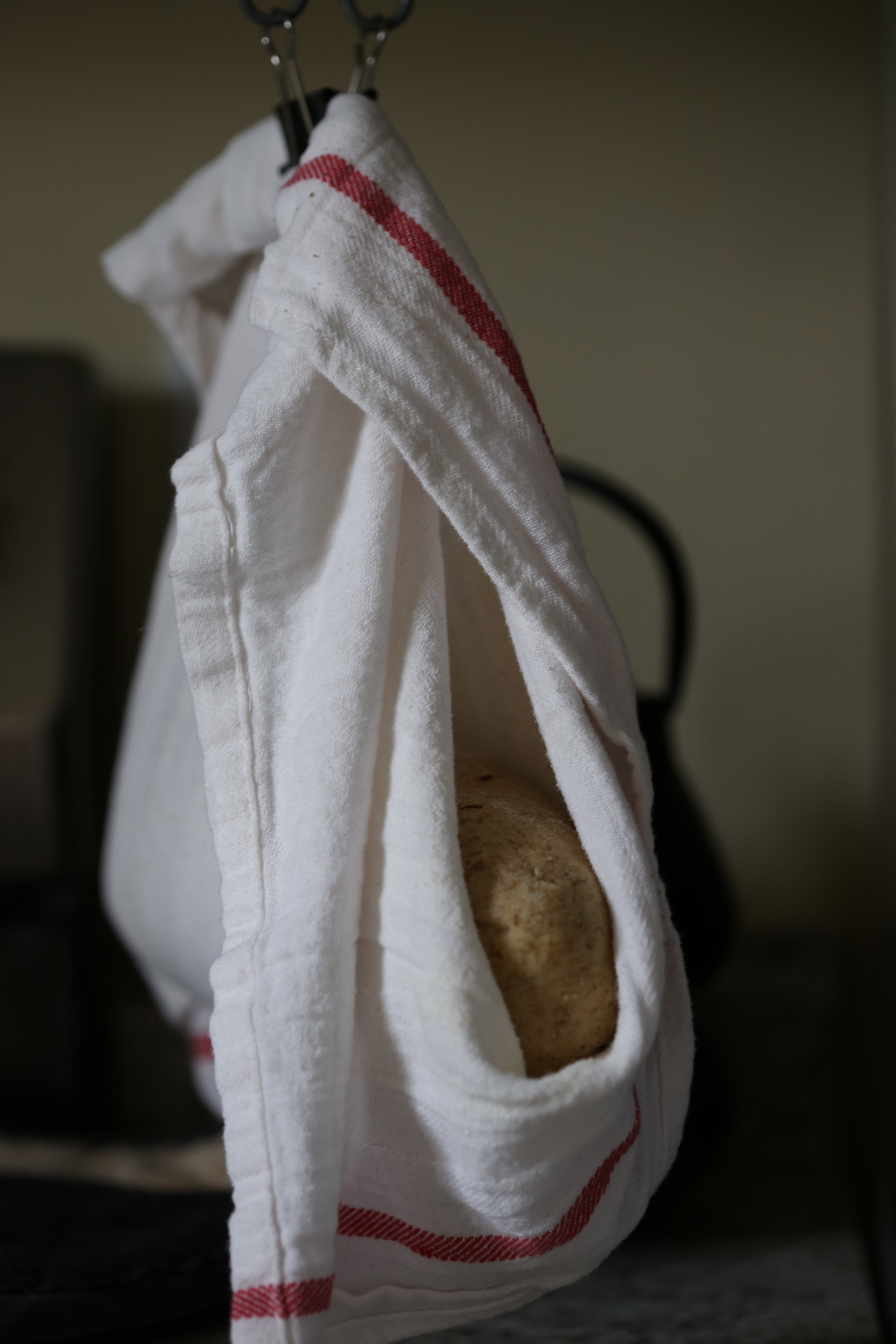
Just as the recipe instructed, I hung the shaped loaf in a towel sling and heated the oven.  As the bread hung in kitchen, it continued to rise and I could see it splitting and I knew it would not get any better in the oven.  Rather than get mad, I decided to take this as a lesson and make another half batch.  This time though, I would make a few changes.

First thing I did was to cut back on the amount of rye flour.  Since I was using whole grain, I knew it would be denser and I figured a little less would have to do.  Second change I made, a lot more kneading but not all at once.  After adding the majority of the flour to the yeast and water, I mixed the dough until it came together and formed a ball which took about 2-3 minutes and then I simply turned off the machine and let it sit there for about 10 minutes.  Once the dough was allowed to sit and rest, I resumed kneading on medium-low speed for about 12-14 minutes.  To be sure I had kneaded it enough, I attempted a window pane test and while it wasn’t perfect, I could see a huge improvement from the first loaf.
IMG_2459

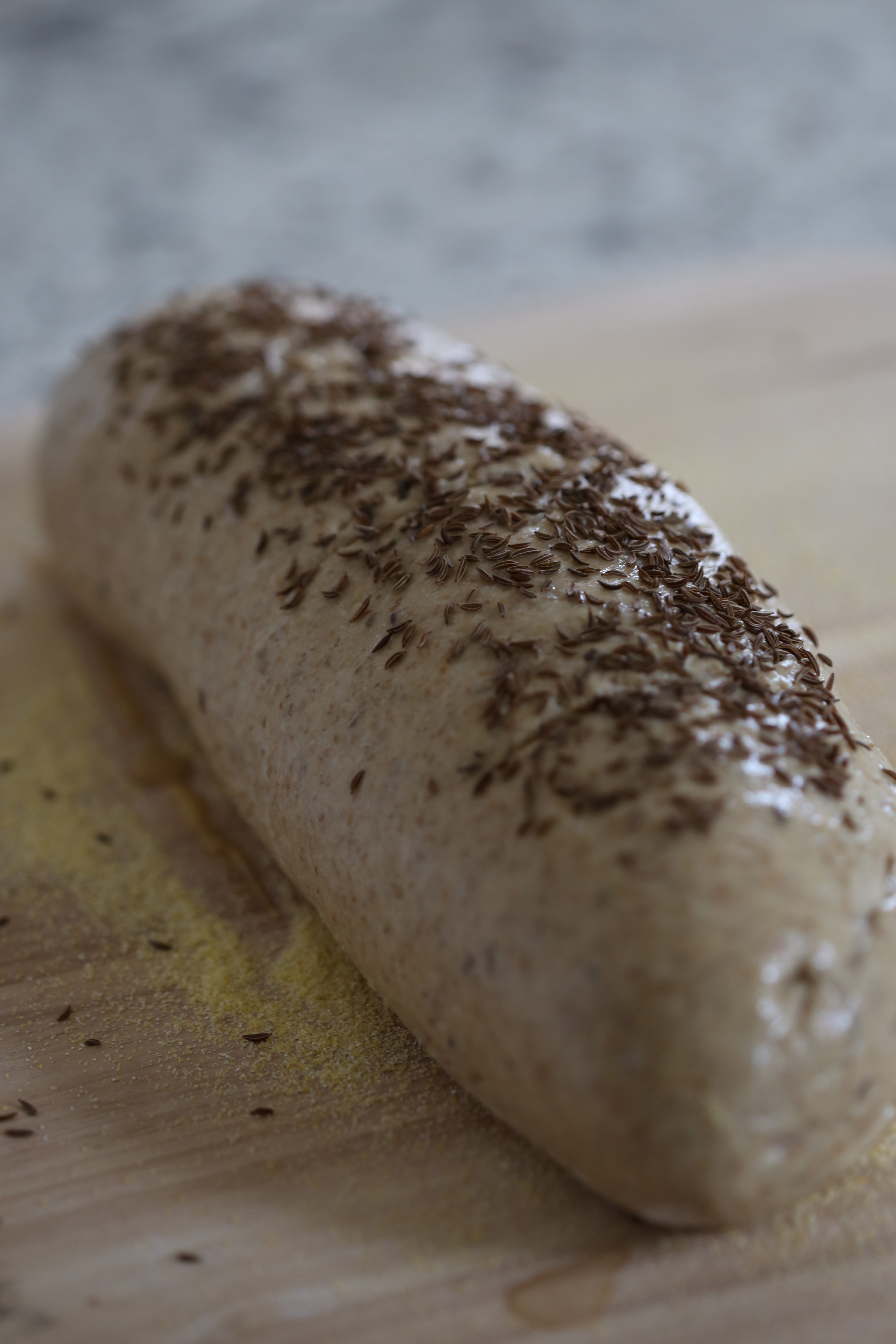
After hanging this loaf in the sling, here it is on the peel just before I put it in the oven.  This time, I gave it a wash of straight egg whites-no water and plenty of caraway seeds.  Just before I slid it into the oven, I gave it a few slashes and crossed my fingers; it couldn’t hurt…

IMG_2466As you can see from the photo, the top loaf is little more than a train wreck.  It split all over and really wasn’t very pretty.  The second loaf is on the bottom and while it is not perfect, it is easy to see that it worked out much better.  This is destined to be one of those recipes I return to multiple times in the hope of getting it right.

IMG_2463The last thing about the recipe that I found difficult to follow from reading it, the shaping method.  Rolling, stand it on the side, pinch, poke, and so on.  Hospital corners-we are talking about bread, right?  For my second loaf, on the left, I just ignored all the fussy instructions and tried to use a little common sense instead.  Looks like it worked out okay, it seems to have held the shape better.  To see the inside of the loaf, refer to the very first photo above, the second loaf is on the left and I think I like the color of that bread better than the first loaf which is on the right.

To see what the other bakers came up with, be sure to visit the Tuesdays with Dorie website and look for the LYL (leave your links) page.

why I garden

IMG_2511

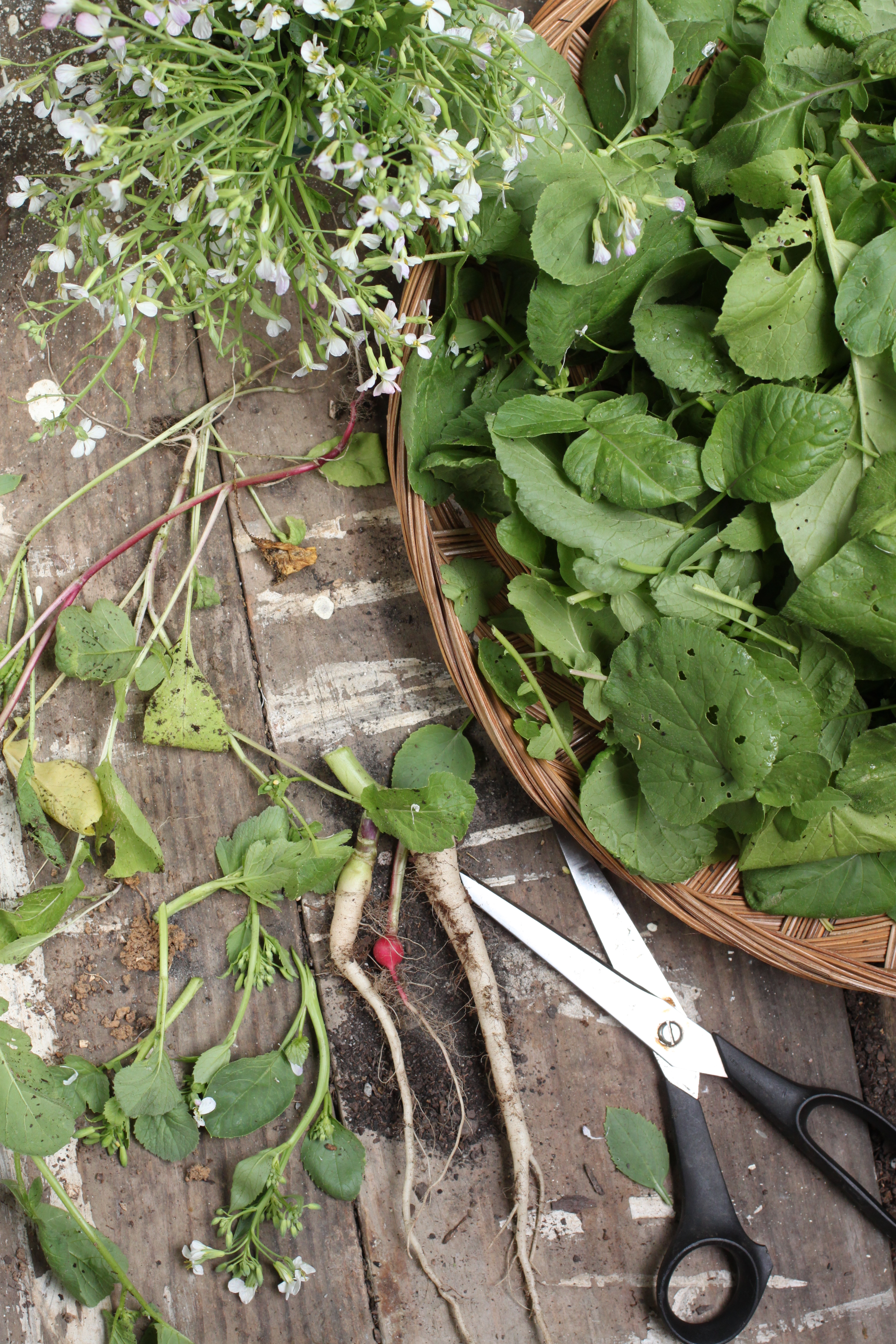
Why do I garden?  There are so many reasons to have a garden but in truth, mine are selfish.  Mostly, I do it because I want to control my food.  To eat only vegetables and fruits that are grown naturally and freshly picked is my goal and growing them myself accomplishes this.  Having the desired varieties of produce at an affordable price is also part of the equation.


IMG_2577

Ego, mainly my own, is also a factor.  There is nothing more satisfying than taking a stroll out to the garden in my yard and filling a basket with vegetables I have grown.  It takes setting goals to a new level.  It can change your entire outlook on life.  As a gardener you must be an optimist; you must believe that simply putting a seed into soil and watering it will result in a plant you can pick and eat.


IMG_2181You must also be able to see the beauty in what is merely a plant.  To surround myself with beauty and to indulge in it and the sense of calm and serenity it bestows upon me.  It is the act of feeding the soul along with the body and the ego that keeps me in the garden.  Plants do not love or hate, they simply thrive or not.  As gardeners, we do the loving; we provide the plant what it needs and then we eat it and the plant in turn gives us what we need to thrive.

IMG_0118

Gardening has given me hope for my future; if I plant it, it may one day give me fruit.  Personally, I am dreaming of peaches and figs.


IMG_0195To reach down into the soil and pull up fully formed vegetables that I can roast or pickle is just part of why I garden.  To have enough to share with friends and neighbors is another reason and I always plant more than I need.

IMG_0298With the words of Mahatma Gandhi, “to forget how to dig the earth and tend the soil is to forget ourselves,”  I continue gardening so that I do not forget that “to plant a garden is to believe in tomorrow,” Audrey Hepburn.  And those are just some of the reasons why I garden.

granola energy bars; a tuesdays with dorie post

IMG_2867

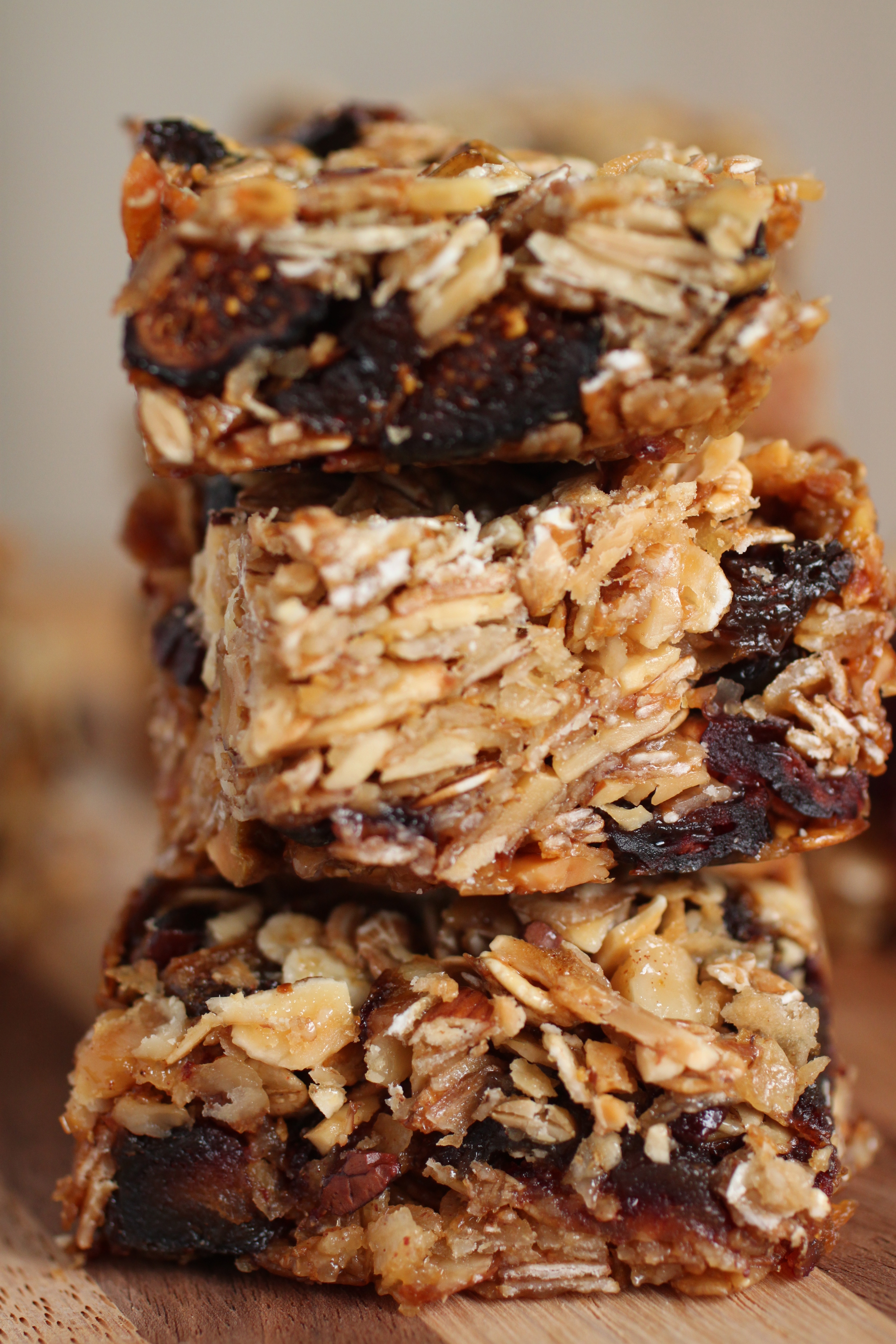
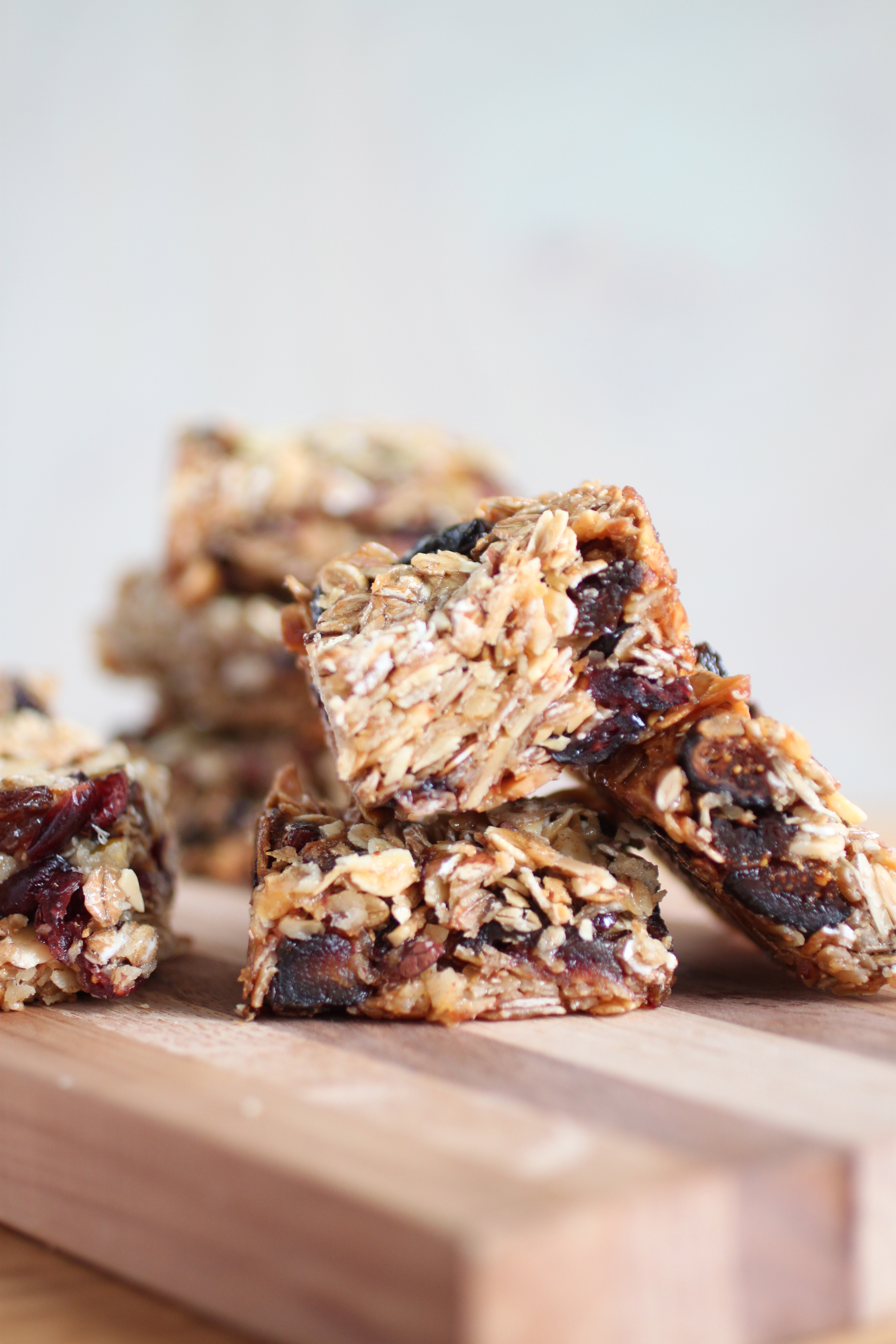
For what seems like forever, I have wanted to make my own granola bars.  When I had to pack lunches for the girls, I would buy them and occasionally, eat some myself, but a single glance at the ingredient list alway left me cringing.  Over the years, I have experimented with granola bars but most of the results just did not give me the chewy but soft texture I was hoping for.  My collection of recipes to try has grown quite a bit and when the Tuesdays with Dorie bakers chose to make the recipe for Granola Energy Bars in Baking Chez Moi, I happily baked along.

The recipe is fairly simple and does not have any tricky steps.  Toast, boil, mix and bake.  Simple ingredients, easy process, what more could a baker want?  The added perk, flexibility as far as what you put in the bars.  The only must, rice syrup something that most supermarkets with a natural food section carry these days.  My thought was to try different combinations of fruits and nuts to make a variety of bars to snack on.  The only thing I did not do was use rolled oats.  Trader Joe’s sells a whole grain hot cereal blend that is made of rolled oats, wheat, barley and rye. There is almost always a carton on the shelf in my pantry and I decided to use the blend rather than just oats.  Working with half the recipe amounts for each batch, I made one batch with dates, cocoa nibs, and walnuts, one batch with Trader Joes Berry Blend (dried cranberries, cherries, golden raisins and blueberries) with almonds and a third batch with mission figs and almonds.  For all of them, I included sweetened coconut and pumpkin seeds, substituted coconut oil for the butter and eliminated the sunflower seeds and the vanilla extract.  
IMG_2872

The mixture was easy to prepare and the three pans came together quickly.  My only wish, that somewhere in the directions it stated how thick they should be in the pan.  The dimensions of the pan is slightly uncommon and with my half batches, I was winging it and hoping that my 6″x 6″ were a good choice.  Since I have had such a problem with the oven temperatures in other recipes, I set the oven to 300F and it took a long time for them to bake, nearly double the time to get them a nice toasty color on top.  This may also have to do with the fact that I did not pretoast my rolled grains; I was hoping to keep them softer.

So what were my results?  Really chewy and almost hard bars that despite the different combinations of fruit, all tasted the same.  Because I did not want them to taste like vanilla, I left out the extract but now I wonder about whether I should have added something like cinnamon because they had an oily taste that must have come from greasing the pans.  In the end, I was a little disappointed with my results but will probably try them again with a full batch of the recipe and a little cinnamon or maybe some pumpkin seed oil and possibly a tiny bit of extract.  As for my husband, he couldn’t eat them fast enough and in a couple of days, had devoured at least half of the bars!

To see what the rest of the bakers came up with, visit the Tuesdays with Dorie website and look for the “leave your links” post.
IMG_2859

three fruit marmalade, like sunshine in a jar

IMG_2432Winter has definitely arrived.  Frigid temperatures and dreary days are quite the norm and I am not thrilled.  Tasked with selling a house and packing to move 700 miles, I feel like I completely missed summer.  We arrived in our new home on the first official day of fall and I have been in a bit of a funk ever since.  Hard to believe but I truly missed the long days spent working out in the garden, shooing away insects, wiping the sweat off my face and nibbling on thick slices of freshly baked cake with friends…

Nothing has felt the same since we moved.  The stores are different and finding the ingredients I need is challenging and I often visit 3-4 stores just to buy most of what I seek.  Although, I can buy a bottle of pinot at 9am on a Sunday if I want because every grocery store in town sells wine.  But back at home, it sinks in, there is no garden full of cake nibbling friends here.  And then, before I even had a chance to blink, the holidays arrived and our girls came to visit.  Off to the stores I went in search of groceries to make it seem a little more like home for them as well as for us.

What most people do not realize is that citrus fruits come into peak season beginning in November.  Just walk into an Asian produce market and you will start to see the different varieties of fruits increase as the Chinese New Year approaches.  While this may seem like such a random thought to share, both of our girls were born in San Francisco and the city is home to the largest Chinese New Year Celebration in the world held outside of China each year.  Half a million people line the streets to watch the parade and it is an exciting experience.  The different fruits all have different meanings but the most important part, the stem with its leaves still attached which is a symbol of longevity and they are highly sought after for New Year Celebrations.

Years later, living in Tennessee, we missed this tradition and the ability to find a lot of the different fruits.  But over time, that slowly changed.  One thing that remained constant, our girls still love citrus fruits and a holiday season just isn’t right without a box of clementines on the counter.  While we do not have an Asian market close to our new home, clementines are so easy to find that I purchased a box on one of my trips to the store.  As always, there are a few that end up living on the counter for a while and this year was no exception.  The girls are not the only ones crazy for citrus fruits as my husband has a love for blood oranges.   On my last trip through Trader Joe’s I picked up a bag for him to snack on thus adding to the collection of fruit in the kitchen.  So that nothing would go to waste, I decided to try my hand at a batch of marmalade.

IMG_2433

Since there were a dozen or so blood oranges in the bag, I decided to sacrifice a few and combine them with the clementines and a container of kumquats that was lurking in the fridge.  Yes, kumquats; a story for another day…  Then I began looking for a recipe.  Have you ever looked at marmalade recipes?  They are time-consuming and somewhat labor intensive.  Peel, dice the rind, simmer, drain and so on.  For a few minutes, I thought maybe not this time.  My desire to make just a few jars of marmalade was waning; I did not want to waste the entire day on this.  Then I picked up a small book from my shelf; Well Preserved, a jam-making hymnal by Joan Hassol.

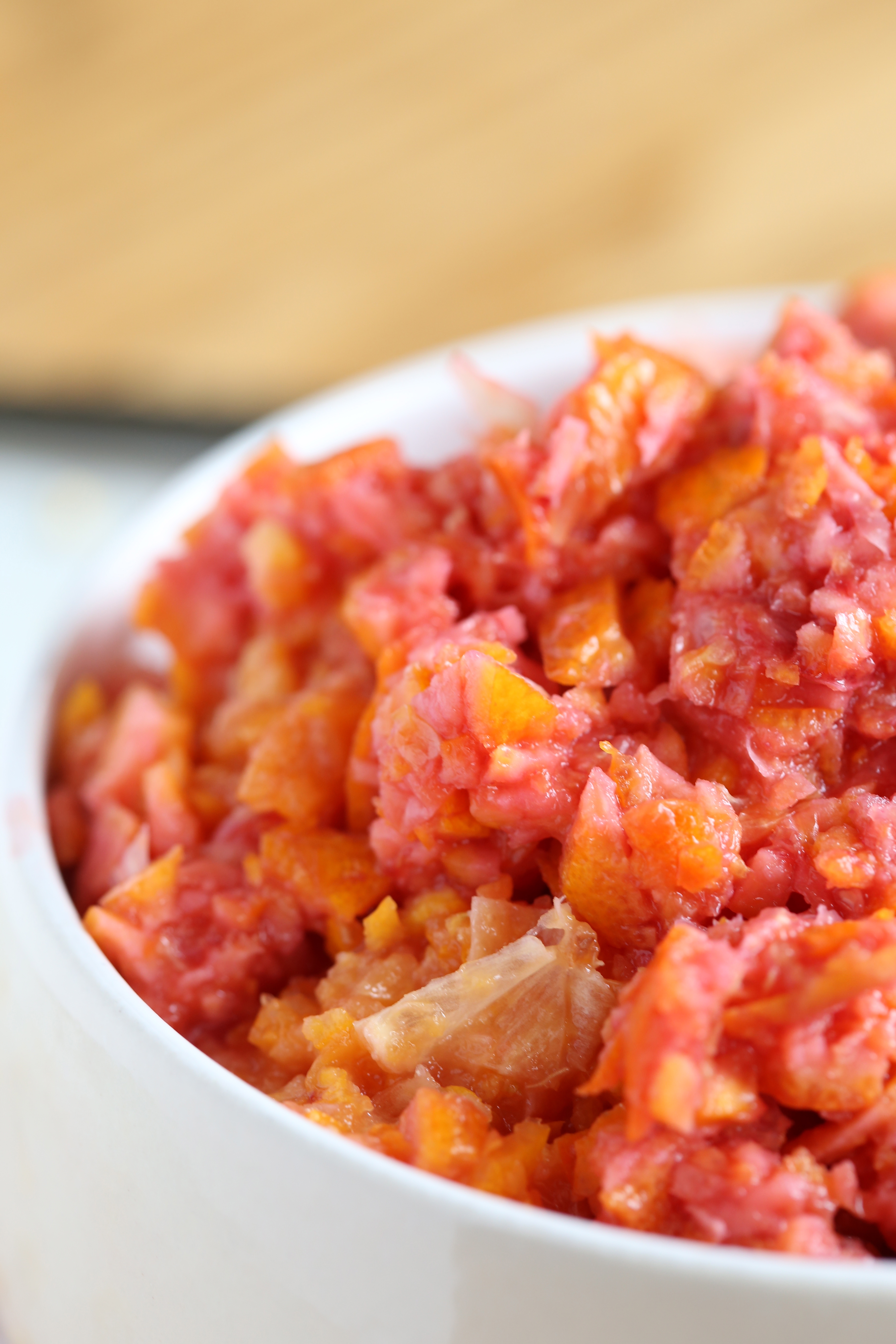
Suddenly, the intimidating process of making marmalade seemed so simple, so easy, so hard not to make!  The recipe has basically four steps; chop the fruit in a food processor, mix all the ingredients in a pot and simmer for 15 minutes, let it rest overnight and then simmer it again for 15 minutes.  Done.  Finished.  Finito.  No peeling, no slicing, no fuss.  Works for me!  Quickly, I cut 4 clementine and 4 blood oranges in half, removed the pits and cut them into chunks.  Then I cut the kumquats in half and pulled out the pits if they were large; this took about 10 minutes.  The food processor came out of the closet and I pulsed the fruit into a pulpy mess pretty quickly.  Sure, there were some large chunks but I didn’t give it a second thought.  Into the pot the fruit went a total of 4 cups of chopped fruit/juice with 3 1/2 cups of water, 8 cups of sugar and a box of pectin.   Once it had a gentle boil, I let it go for 15 minutes, turned it off and let it sit uncovered until it cooled.   Once it was cool, I covered it to keep it from collecting strays overnight.

The next afternoon, I brought it back to a gentle boil, let it go another 15 minutes and then put it into whatever jars I could find in the closet.  It was that simple, and honestly, I think I spent more time cleaning up than I did doing anything else.

IMG_2477

Of course, homemade marmalade demands good bread and this is some we picked up from the Smithfield Bakery Cafe in Smithfield, VA, home to genuine Smithfield hams…yadda yadda.  No ham was consumed on our visit, just some really good sandwiches and salads and a loaf of the Honey Almond Bread.  A quaint little place, Smithfield was well worth the ferry ride across the river.
IMG_2489

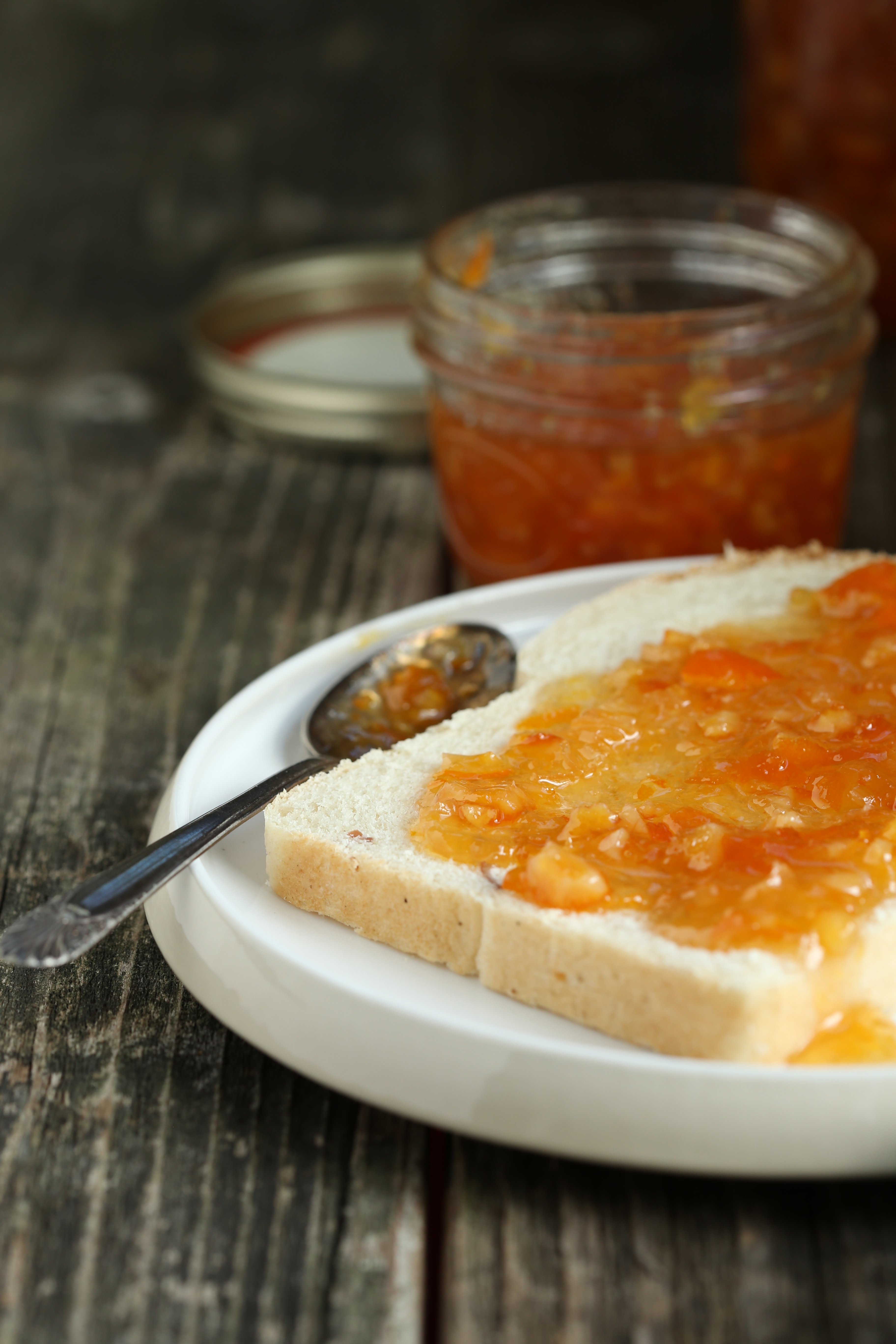
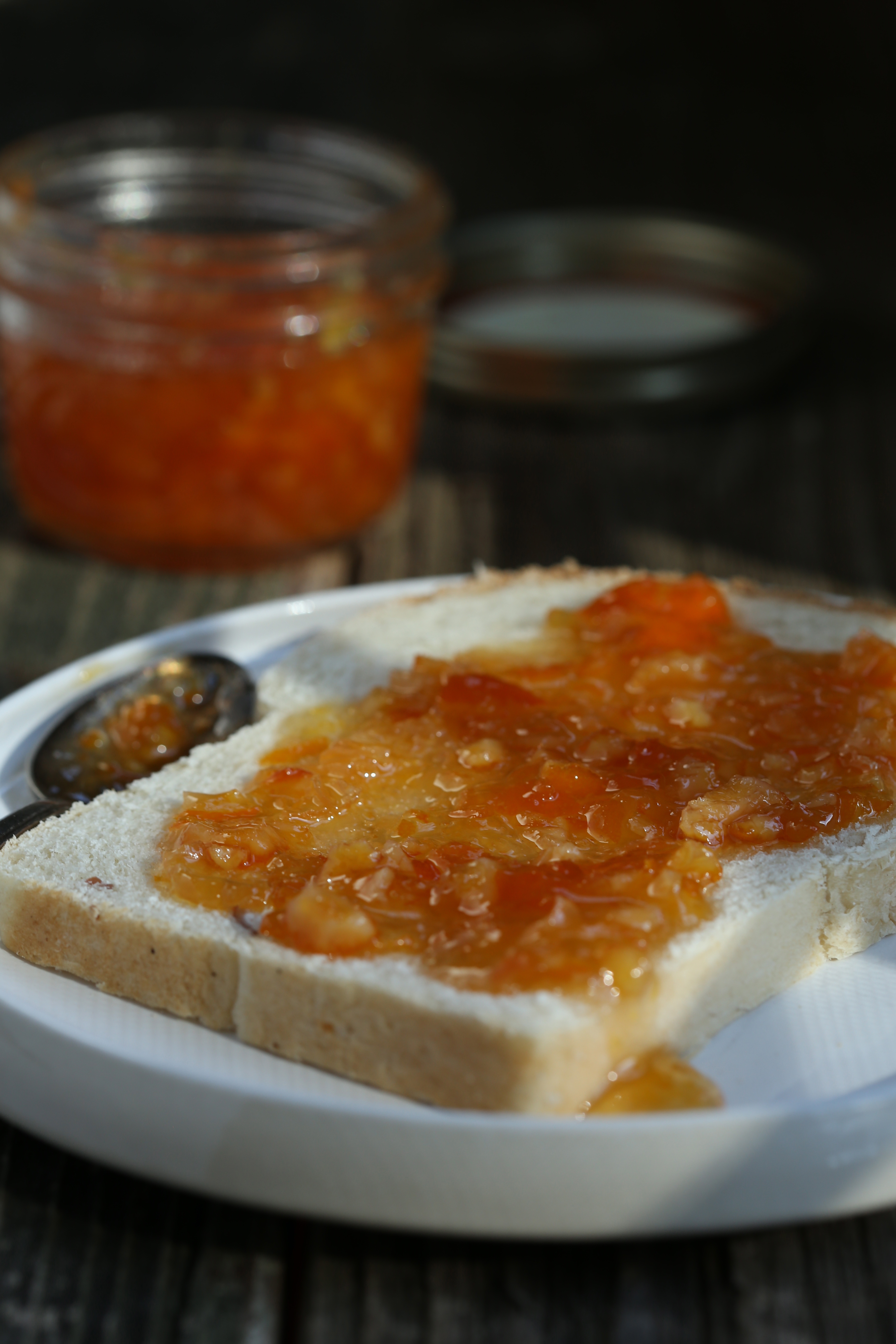
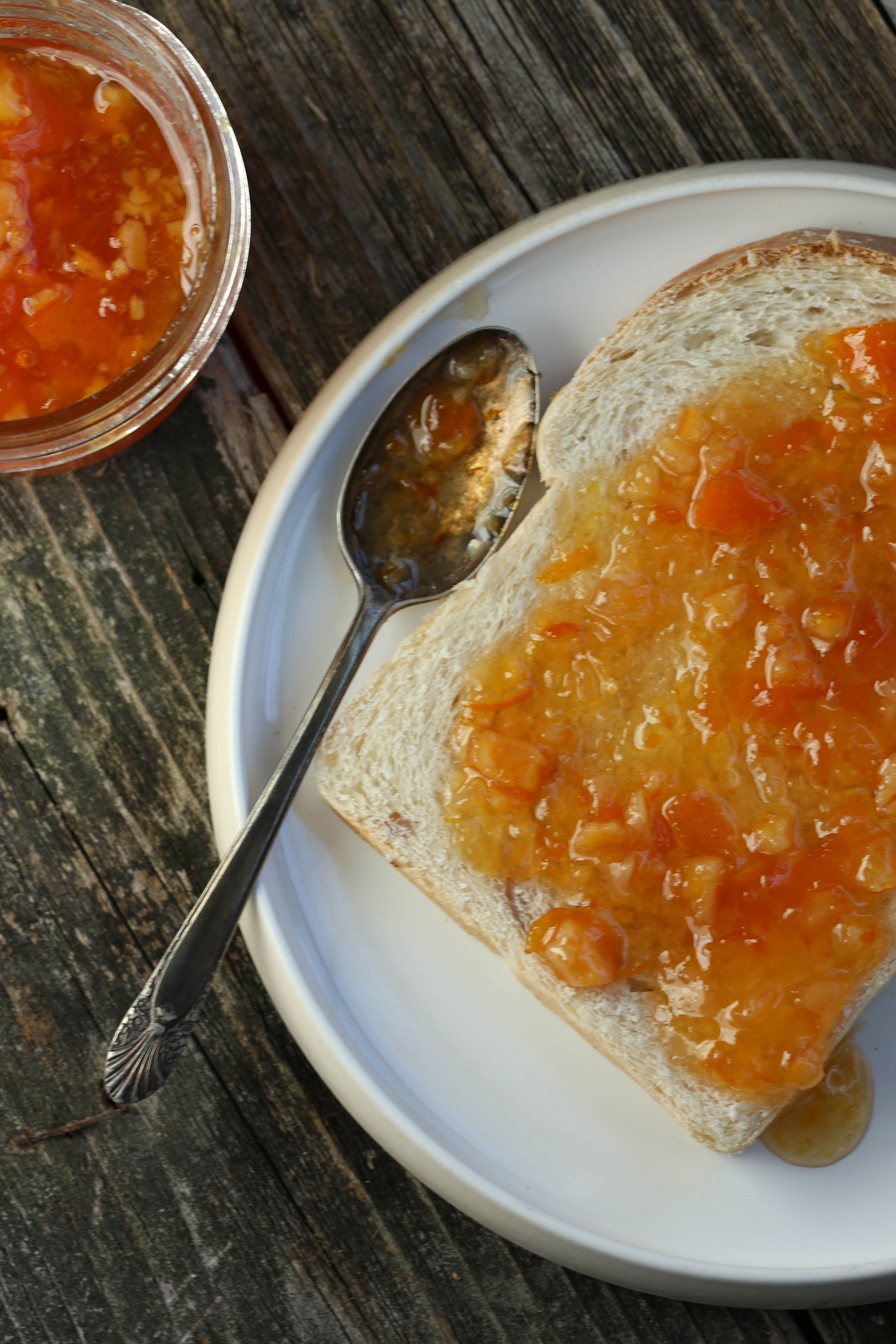
For the first time in a few days, the sunlight was streaming in through the kitchen windows and it made the bright orange marmalade glow.  Honestly, I expected more of a pink tint from the blood oranges but even so, I love the bright color.


IMG_2502Definitely sweet but so full of bright citrus flavor it really was like a little bit of sunshine to brighten my morning.

IMG_2505

My favorite thing about the recipe was the use of a food processor and the whole fruit.  The irregular sizes of the rind make it look more homemade.  Now that I have finally found what I consider to be a foolproof method, I plan to make marmalade again.  The original recipe calls for the use of pineapple, lemons, limes, oranges and grapefruit but allows for the pineapple to be left out.  It is all based on the amount of chopped fruit; for every 4 cups of chopped fruit, add 8-10 cups of sugar and 3-4 cups of water along with 1 box of pectin.  The amount of sugar depends on the sweetness of the fruit and the water depends on how thick you want it.  My fruits were a bit sweet so I used 8 cups of sugar and 3 1/2 cups of water.

The book is available on sites like amazon however, it is also available on googlebooks and I was able to view the complete recipe without having to purchase it.  Before you chastise me for that, my copy of the actual book is sitting right here next to me as I type, I merely did a search to see if it was online and it is.  As a published author, I respectfully ask that you consider purchasing the book ($12.80 on amazon, $14.99 from the publisher) or borrowing it from a library.  
IMG_2508

cooking the books: pain de mie from Beard on Bread

IMG_1894

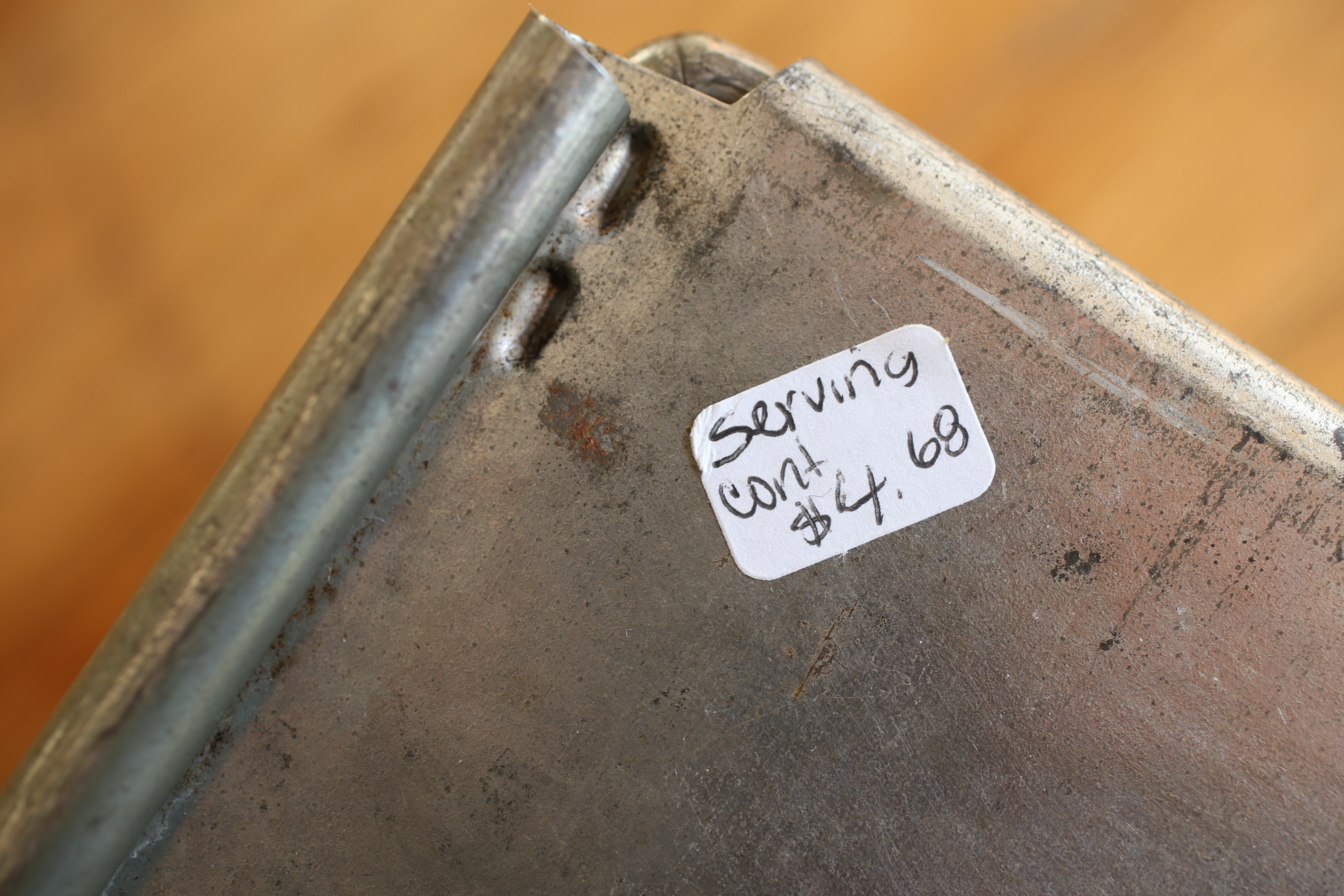
My love of thrift store shopping is well documented.  When I mention that I stopped by the thrift store to my husband, he generally rolls his eyes.  At times, he is so bold as to ask my “why” as if I really need a reason. Truth be told, it is a bit of a game, a treasure hunt for needful things and at times, a source of inspiration.  It is also the way I find a lot of my props and baking equipment and on one such trip, I hit the jackpot; I found a pullman loaf pan for less than $5.


IMG_1887

Pullman loaf pans are not that common and finding one in a neighborhood thrift store typically stocked with clothing and housewares is unusual.  Actually, the folks running the shop had no idea what it was and they assumed it was some sort of serving container.  When I brought it up to the counter, I struck up a conversation with the woman at the register and she told me how they had just put that pan out for sale along with a similar serving container.  Because I knew what it was, I cheerfully explained how it was actually a bread pan, one I had been hoping to find for a while.  As I removed the lid, I explained how it worked and why one would want to use it.  Then I explained that the other “serving container” on the display was in fact a pan for poaching whole fish.  To say that she was stunned by the information is an understatement.  As I paid for my purchase, I thanked her and she then thanked me for taking the time to teach her something about the equipment-they are all volunteers and sometimes, they have no idea what the donated items are.  Then she went off in search of the poaching pan so that she could give it a proper label.


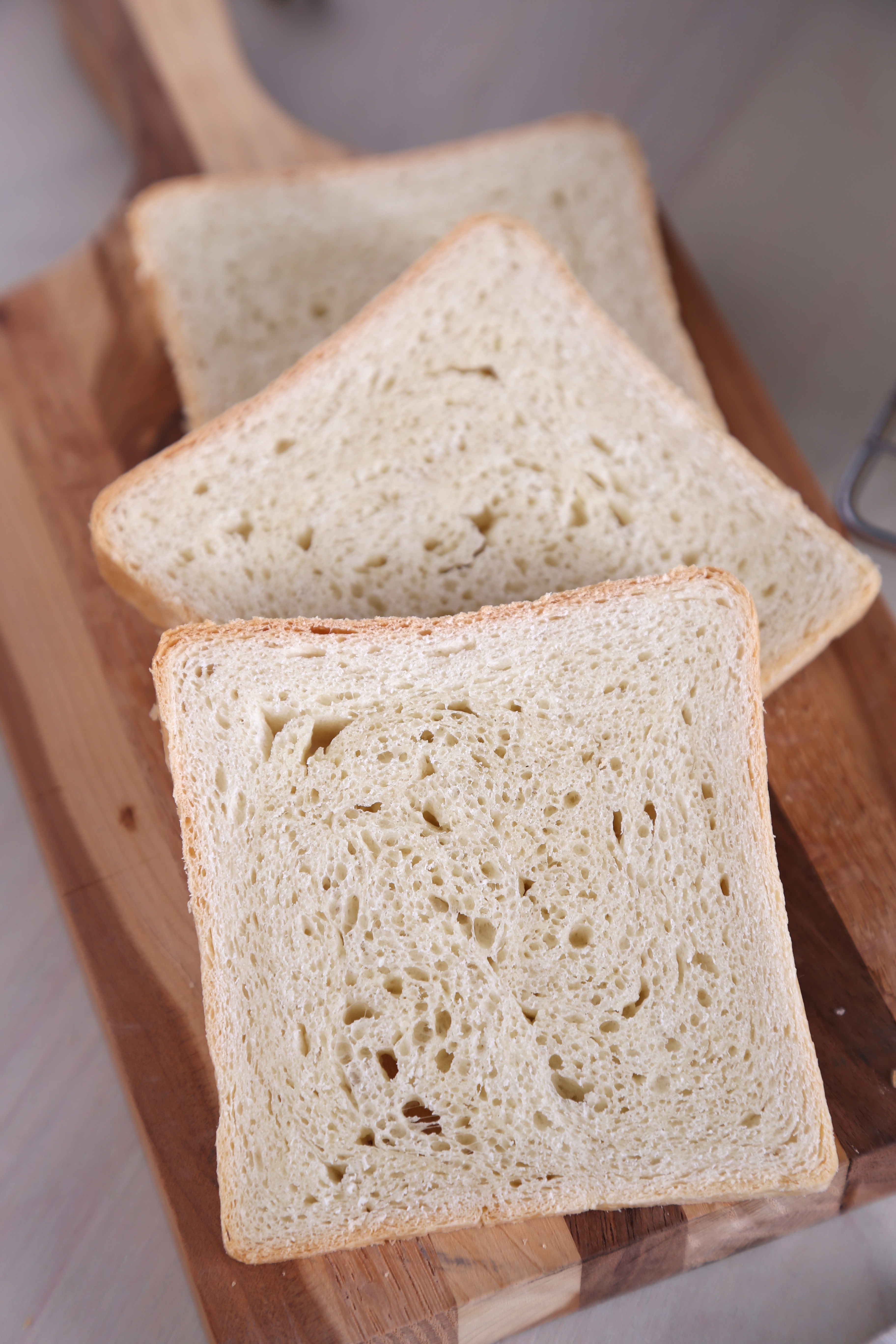
IMG_1906So what is so special about this pan?  The shape, of course!  The straight sides and the bottom width, as well as the top width are all the same, about 4 inches which gives a loaf of bread baked in the pan perfectly square slices.  That is providing you bake it with the lid on.  The lid prevents the dough from rising out of the pan and forces it to fill all the corners of the pan.  It can also prevent large bubbles from forming in the bread therefore the texture is a little denser than typical sandwich loaves.

Since my large collection of kitchen paraphernalia also includes a wall of cookbooks, I have decided that I need to use them more often.  Call this post the first of my “cooking the books” series and today’s recipe is from the classic baking book, Beard on Bread.  Actually, finding a pain de mie recipe in my collection of baking books was difficult; only two books had a recipe.  After reading them both, I went with the recipe from Beard on Bread because it was the simpler recipe of the two.

IMG_1912The first thing I noticed about the recipe, it had a lot of yeast in it.  So much that when I set the yeast into the water and sugar to proof, it foamed up like crazy.

IMG_1914

Then when I began to add the other ingredients and started mixing, I nearly panicked.  The mixture seemed so dry and crumbly that I was sure I did something wrong.  In the future, I would probably add a little less flour to get a slightly softer dough.


IMG_1915Luckily, as the dough mixed, it came together and the longer it kneaded, the smoother it became.

IMG_1916

The ball of dough after the first knead is ready for the first rise.  That is correct, the first knead, this dough is unique because it is kneaded at each of the three rises and then shaped and allowed to proof in the pan.


IMG_1921

While the repeated rising and kneading does not make for a quick loaf of bread, the fact that it is so perfectly square gives it a great yield in slices making this the perfect loaf for a picnics worth of sandwiches!  It not only freezes well, makes glorious toast and grilled cheese sandwiches the square shape lends itself to picture perfect croutons.  There really are very few reasons not to make this bread so get yourself a pullman pan and get to kneading!

Pain de Mie
IMG_1965adapted from Beard on Bread by James Beard

Alfred A. Knopf, 1973

yields 1 pullman loaf, 13″x4″x4″ loaf

2 packages active dry yeast-4 1/2 teaspoons

1 1/2 cups warm water, 100-115 degrees F

2 teaspoons sugar

5 1/2-6 cups all purpose flour

5 teaspoons kosher salt

4 ounces unsalted butter, soft

Proof the yeast in a half cup of the water with the sugar until it foams.  Place 5 cups of the flour in a large bowl and stir in the salt.  Using a pastry blender, two knives or your fingers, cut in the butter so that the mixture resembles a coarse meal.  Stir the remaining water into the yeast and then pour the mixture into the flour.  Using a wooden spoon or your hand, mix the dough to form a stiff but slightly sticky dough.  Begin kneading by hand or in the bowl of a stand mixer for at least 10 minutes.  When smooth and somewhat elastic, allow it to rest for a few minutes.  Shape the dough into a ball, coat it in oil and place it in a greased bowl to rise until doubled, about 1 1/2 hours.

Punch the dough down, let it rise again for a few minutes and then turn it out onto the work space and knead it again for 3-4 minutes.  Shape it into a ball and return it to the greased bowl, oil the top of the dough and let it rise again until doubled, about 1 hour.  Once again, punch the dough down, let it rest and then knead it for 3-4 minutes.  Grease the pan and the inside of the lid, shape the dough into a loaf that fits the pan in length and place the dough into the pan but set the lid aside for now.  Allow the dough to rise until doubled, preheat the oven to 400F.

Slide the lid over the top of the pan and place the bread in the hot oven.  Immediately turn the oven down to 375F.  Bake for 30 minutes and then turn the pan over onto its side and bake for 5 minutes.  Once again, turn the pan over and bake on the other side for 5 minutes.  Turn the pan upright, remove the lid and continue to bake until it is golden brown, about 12-15 minutes.  Take the bread out of the pan and put it directly on the rack in the oven and bake for 5 minutes until the sides are nicely browned and the internal temperature is 200F.  Remove the bread from the oven and cool completely on a rack before slicing.

IMG_1966

tuesdays with dorie

Mixed starter bread from Baking with Julia, baked in early December 2014.

Each Tuesday, the members of the Tuesdays with Dorie blogging group post photos and comments on the challenge of the week.  If you are not familiar with the group, we are currently baking our way through two of Dorie Greenspan’s books; Baking with Julia and Baking Chez Moi.  The recipes are chosen by the members each month and we post them on alternating Tuesdays, two recipes from each book.

This week, we are posting about our experiences with the Inside-out, Upside-down Tiramisu recipe from Baking with Julia.  However, I chose not to make this recipe.  Crazy, I know, but over the years, I have made so many batches of tiramisu that I just did not want to make it.  We just do not eat that much dairy and with just the two of us, I could not see the point in making it.

Fear not, I will be back again for the second Baking with Julia recipe this month because I love rye bread and the scheduled recipe is the Eastern European Rye bread on page 98.  As I mentioned above, I also participate in the Baking Chez Moi recipe challenges and next week, we are baking the Granola Energy Bars on page 328 and they sound interesting enough to me that I am looking forward to the results.

If you are interested in baking along, pick up a copy of either book and visit the website to see the schedule.  Be sure to visit the website each Tuesday and look for the “leave your links” post to read the experiences of all the participants.  Not only will you get tips and tricks to use when baking, you will get first hand reviews of each recipe, insider information if you will.  However, you will have to buy or borrow the books, we make it a rule not to publish the recipes.  Join us, we’d love to have you bake along with us!

gardening from the ground up; starting a new garden

IMG_2402

When we moved from our home in Nashville, we had to leave our garden behind.  It was difficult to leave it; we had worked so hard to establish beds and more importantly, spent so much time nurturing plants of all kinds.  From herbs to fruit trees and perennials to attract beneficial insects and butterflies, our garden was a work in progress and we were sad to leave it behind and there isn’t a day that goes by that I do not miss that garden.

When we began the process of searching for a new home in Williamsburg, the layout of the yard was just as important to us as the house itself.  We knew it had to be a space where we could grow a garden that included honeybees and hens.  Luckily for us, we were able to find a home with what we think will be the place for a beautiful garden that will provide us with plenty of space to grow what we need to feed ourselves.  And yes, that is quite a lofty goal, to feed ourselves but  in the grand scheme of things, if all of us made the move to grow something to consume rather than purchasing it all, surely it would make a difference.  Of course, that is  providing it was done organically, but that is a conversation for another day.

For some time now, I have wanted to grow at least 50% of the produce my husband and I can eat.  As urban dwellers, we are restricted by laws that do not allow livestock and we are okay with that, we have no desire to raise animals for meat.  But fresh eggs and honey-those we can produce in our neighborhood and that is a great start. However, unless we get a garden growing, we are going to be purchasing everything from the grocery store.  
IMG_2018

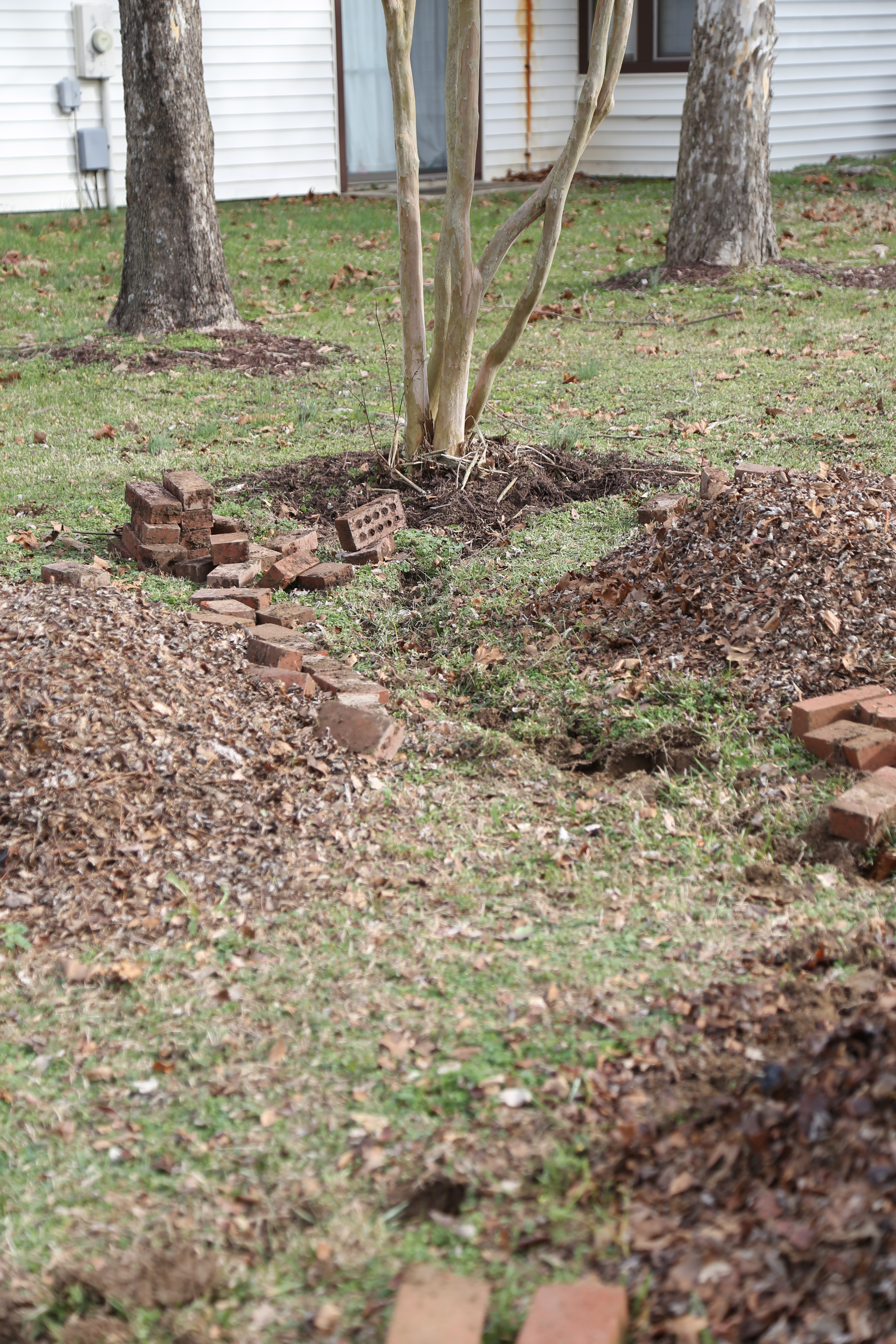
For the time being, I have put aside a serious search for employment in the hope of working from home.  Knowing that we would have a reduction in income, we made the decision to build our garden from free materials as much as possible.  Luckily, we have a lot of large trees in our yard and having trees means having lots of leaves!  We gathered up as many as we could and made piles all over the front yard so that they could begin the important process of breaking down into soil.  Gardening naturally and inexpensively doesn’t get any easier than the lasagna method.  Building the beds from the ground up, layer by layer makes beds full of natural humus teeming with beneficial micro-organisms.  The only down side; quantity.  Since everything breaks down over time, you need large quantities to fill beds.  For now, we have leaves and cardboard and a supply of coffee grinds and in time, our own compost.


IMG_2403

Recently, I sat down and designed the layout for our garden.  We made the decision to use the front yard for our beds since it gets the most sun.  Our choice of the front yard seems odd to some but in all honesty, what purpose does a beautiful lawn serve?  It is time-consuming, it has to be mowed, chemicals come into play and in the end, you cannot eat it!  We have a dog and she too needs space to run, so the back yard is being reserved for things like a dog run, a chicken coop, a bee yard and whatever else we want to do out there-a barbecue pit comes to mind.

IMG_2404

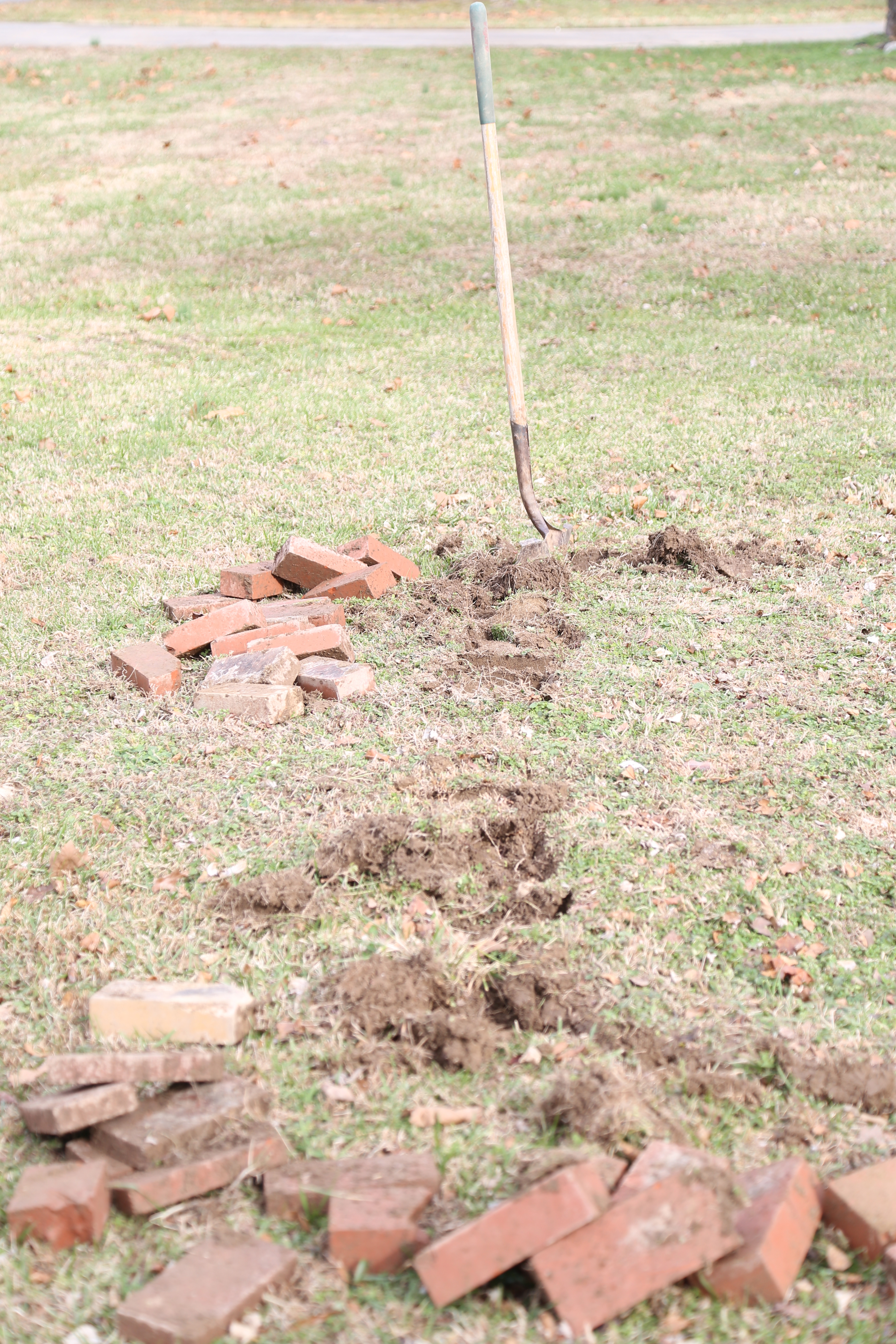
On a recent afternoon, we discovered a bunch of bricks laid out in the front lawn.  It seems that previous residents had a bed in the front yard and over time, the lawn grew over the bed.  We grabbed a couple of shovels and began digging them out of the lawn.


IMG_2405

It was an oddly shaped bed built from a random selection of bricks that were most likely left from another project.  They circled a crepe myrtle and looped around a corner of the yard.  Since we were preparing to build our garden, finding free bricks was a happy surprise.  They definitely fit the budget and will come in handy for outlining a bed.


IMG_2407

The bricks were in the lawn for some time, the grasses and weeds were well established over the tops of each brick and it was fairly easy to scrape it away.  The unhappy surprise, our soil is mostly clay.


IMG_2409 So what do we have here?  The cardboard serves as a compostable weed stop layer.  It will slowly breakdown and as the process takes place, the plants growing in the lawn underneath it will die.  We have been stopping by a Starbucks regularly for coffee grinds-did you know that they have a “Grounds For Your Garden” program? Not every store participates which is sad but if your local shop does, grab some!  We have been using them in our new beds by pouring some on top of the cardboard and then topping it off with the leaves.  The high nitrogen content of the grounds will help the leaves compost. Even with the discovery of clay soil, we are confident that we can be successful gardening out front.  The truth is, as the leaves, coffee and everything we layer into the beds breaks down, we will have a beautiful, black layer of compost that we can turn into the soil to amend the structure.  While the coffee grounds may not be organic, we are not using any synthetic fertilizers and that in my opinion, is a huge plus!

Be sure to visit here often to see how the garden progresses!

gingerbread buche de noel; a tuesdays with dorie post

IMG_2398

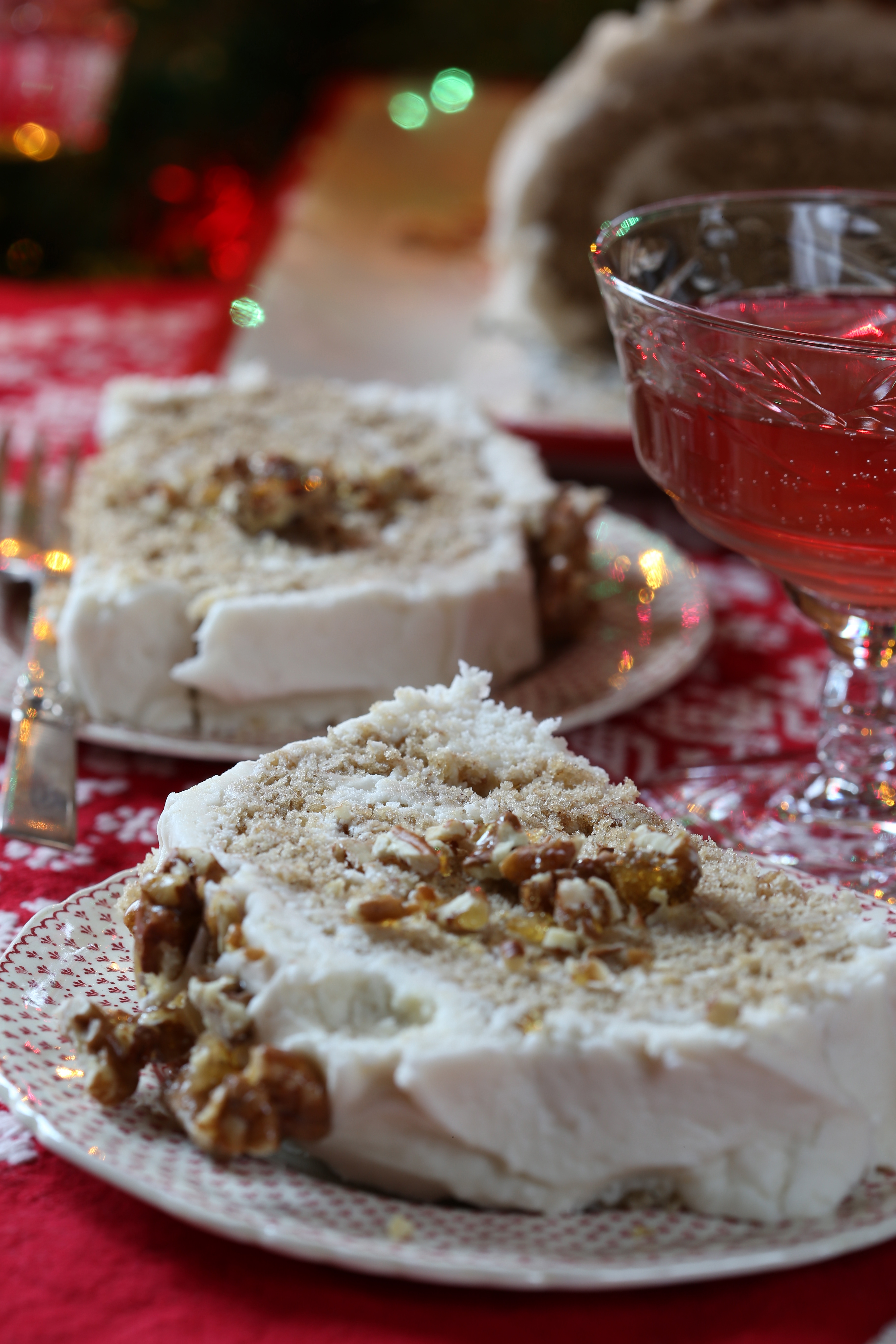
To keep it seasonal, the Tuesdays with Dorie bakers chose to make the Buche de Noel from Baking Chez Moi.  This traditional holiday cake roll is frequently decorated to look like a tree log complete with textured bark, leaves, pinecones and even mushrooms.  Thankfully, this rendition was much simpler and the only ode to the holiday was the gingerbread spices added to the cake.

Just as you might expect, the holidays came and went faster than anyone could believe was possible.  Why is that?  Why are we in such a rush to get it done, get it finished so quickly that we scarcely have time to enjoy it?  Whatever the reason, I propose that shift it into slow gear for next year, I would really like to enjoy the day a little more!  Regardless, I finally had a chance to get the Buche de Noel finished although, it was two days after Christmas; better late than never, right?


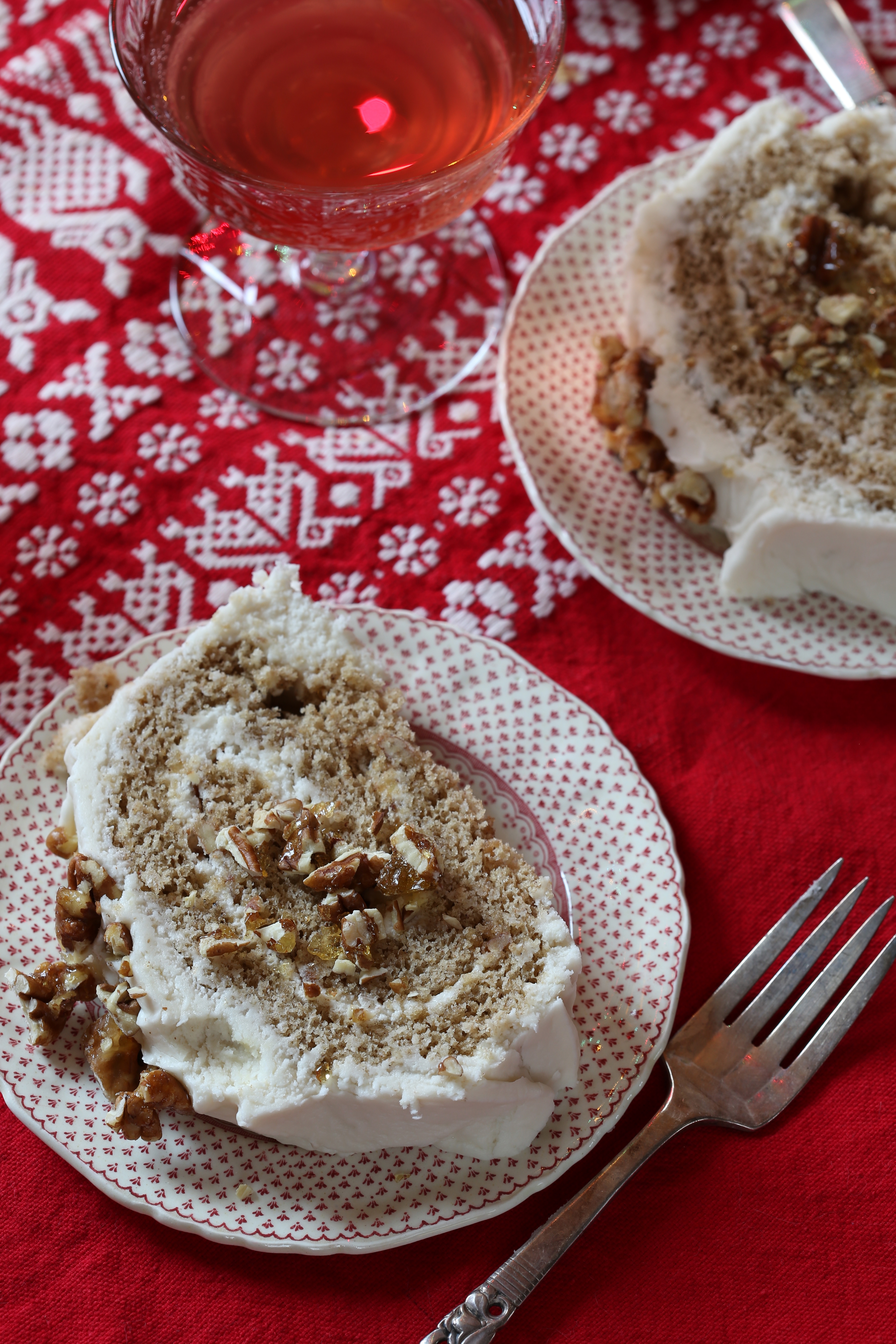
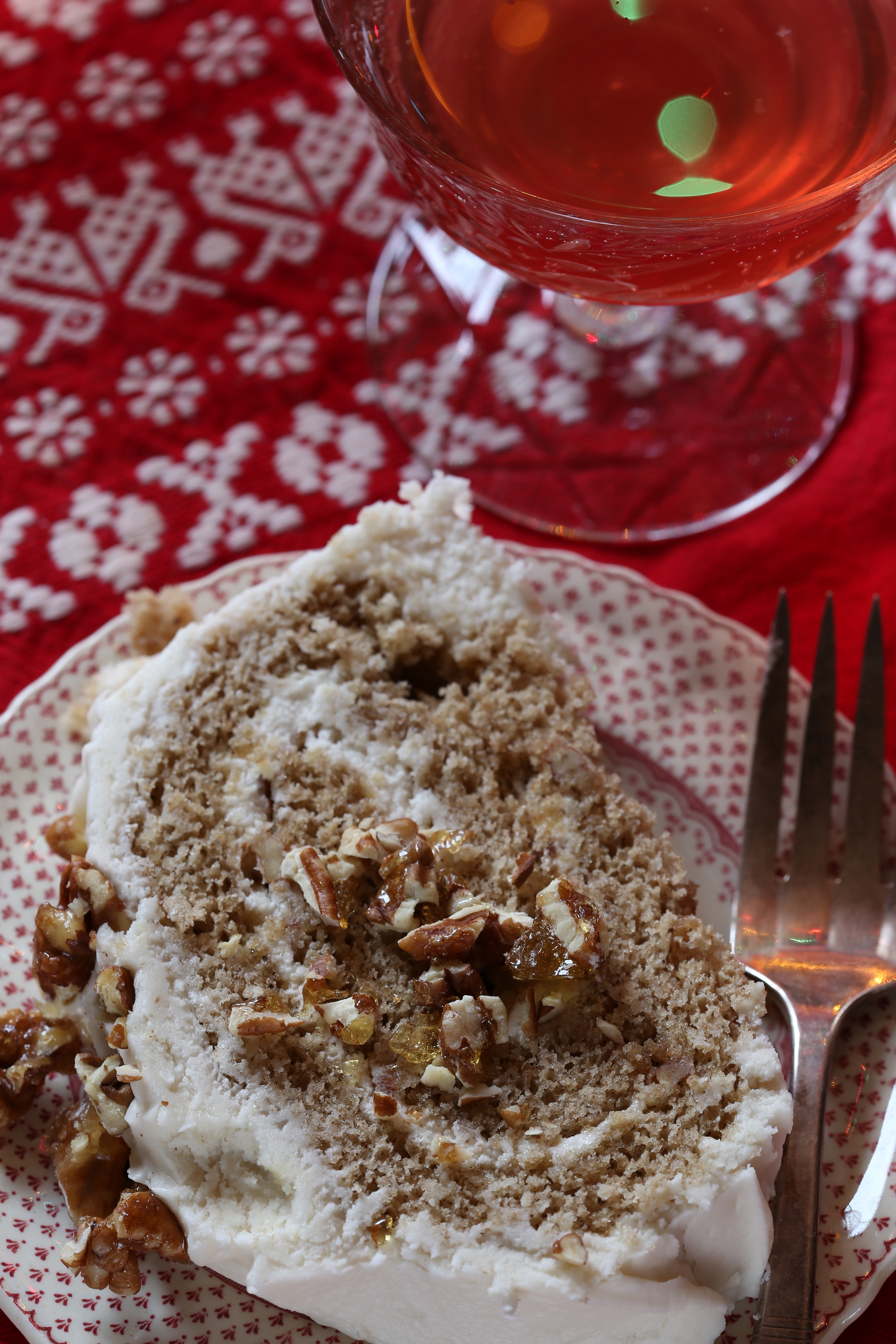
IMG_2395For those of us who work in or have worked in bakeries, we know that Yule log cakes are pretty common.  Usually, it is a yellow cake spread with a thin layer of chocolate filling and rolled up so that a slice resembles the rings in a tree log.  The recipe in Baking Chez Moi is unusual in that the filling is simply a mixture of cream cheese and butter sweetened only with a small amount of finely chopped pecan praline.  The differences continue with the use of a marshmallow frosting and a sprinkling of coarsely chopped praline pieces.   Somehow, the idea of spreading a mixture of cream cheese and butter into a delicate sponge cake seemed a little heavy to me and I knew I would be making changes.  My choice was to whip up a nice, fluffy batch of cream cheese frosting and I am glad i did;  we thought it was the perfect filling and frosting for my Buche de Noel.

However, before I could do anything, I needed to get the cake baked and that my friends, was just the beginning of my troubles!  To get things started, I decided to make the cake using my hand mixer because all of the parts of my stand mixer were in the dishwasher.  Can I just say that using a hand mixer is not an option when making a genoise.  No matter how much I whipped, with the beaters first and then the whip attachment, the eggs and brown sugar just never formed a ribbon which is essential for a genoise.  In my opinion, the use of brown sugar did not help since I feel it affected the ph balance of the mixture and prevented the eggs from reaching the proper ribbon stage.
My solution to the whole matter was to make the cake a second time but with a different method.  First of all, I used room temperature eggs and white sugar.  Heating the eggs and sugar and whipping them on high-speed is the common approach but my experience is that a better, stronger structure is formed from room temperature eggs whipped a little slower.  Brown sugar is tricky to use in this instance simply because every brand is different.  Have you ever held the different bags together and looked at the colors of them?   Even bags from the same manufacturer can be a different shade when compared side by side.  There just does not seem to be a true standard of color for light and dark brown sugar.  In my book, it makes brown sugar a bit of a wild card and not my first choice for a recipe as fickle as a genoise.  The fact that my first cake turned out to be a two toned sheet of rubber confirmed my suspicions and not only will I not use brown sugar but I will also not ever try this with a hand mixer either!!
IMG_2391

With a fluffy sheet of genoise cake subtly spiced with ginger, cinnamon, cardamom, cloves and black pepper, I set to work on rolling the sheet as per the directions.  Can somebody please tell me why this is done?  Over the years, I have made many rolls of cake without ever pre-rolling a single one.  I’m sorry but if you ask me, it is a bad move.  Just as I suspected, the cake cracked into pieces when I unrolled it to fill it.  This really annoyed me after the trouble I had with the cake itself.  In the future, I will store my layers in the fridge flat-out on a pan until I need them.  As it was, I carefully spread some of my cream cheese frosting over the cake taking care not to damage it any further.  To keep it in the spirit of the original recipe, I sprinkled the finely chopped praline over the frosting and rolled the cake back up.  Then to finish it off, I spread a generous layer of frosting over the entire log and topped it all of with the remaining praline pieces.


IMG_2388

We enjoyed thick slabs of the cake topped with sprinkles of praline while sitting by the fire, the room glowing from the lights of the tree.  Finally, we had the chance to enjoy Christmas, too bad it wasn’t until a few days later…

So, here’s to a happy and prosperous New Year!  Check out the Tuesdays with Dorie page to see how all of the other bakers made out with the recipe! 
IMG_2396

while visions of sugar-plums danced in their heads; decorated gingerbread cookies

IMG_2290

Fancy decorated cookies at Christmas are a given.  They can be found in stores and bakeries and even online.  Good friends give them as gifts and others share them in cookie swaps.  Our family is no different and we bake batches of them each year.  Mainly, we share them with family and a few special friends.  One family tradition we have is for our girls to decorate a batch of sugar cookies to give as a gift to their cousins each year.   Truth be told, they go out of their way to make them the craziest, most outrageous and quite honestly, the ugliest cookies a trio of boys (“the cousins”) have ever seen.  After dinner when dessert is on the table, many laughs are shared and many cookies are consumed.

Now that we are in Virginia, our tradition of sharing them on Christmas day will not be possible.  We will have to send them on to the boys via the post office and they will not arrive until after Christmas.  Even so, all is not lost!  Having a fair amount of time at home this holiday season, I was able to decorate a batch of gingerbread cookies to send out in time for the family Christmas dinner in Kentucky. 
IMG_2289This was the first time in a very long time that I had the time to give cookies any real thought.  In the end, I chose some of my favorite cutters and let my inner Martha loose in the kitchen.  Many batches of royal icing were whipped up and with my bottles of gel colors, I mixed up a rainbow of icing paints.  After digging through my equipment, I found all of my couplers and tips and I got to work.  The little nonpareils and white pearls just added to the fun and I was quite content to spend my day decorating cookies.

IMG_2288

One thing I generally avoid, anything with faces.  While I can mix up colors and frost cookies all day, faces are not something I like to do; my skills just aren’t that good.  At least until now, these gnomes were pretty easy to make and while they aren’t very lifelike, they are really cute!


IMG_2281All nestled in one of my vintage tins from the thrift store

IMG_2296

And since I was taking the photos with the tree as my background, here are a couple of my favorite ornaments.  My collection has many glass ornaments, quite a few have been hanging on our tree for 30 years.  For years, I have collected food ornaments and if you look at our tree, it is not unusual to find things like a head of garlic, a broccoli stalk or a can of soup hanging along with pretty glass globes.  One of my favorite types of ornaments are the ones that slip over the lights and glow.  This crazy one is a lighthouse and it is covered with glitter.


IMG_2295This little bisque bird is a creamy white but it takes on whatever color the light is.  This year, it is glowing yellow and I like the way it looks; the lighting shows off the feather details nicely.

Here’s hoping you have a sweet holiday!  Happy Christmas to all, and to all a good night!

the stockings were hung by the chimney with care: a hand-knit family tradition

IMG_2073
My stocking for baby Matthew on the left, the stocking Joan made for me when I was born is second from the left and the others she made for my husband and daughters.

Every year as we decorate the house for Christmas, our stockings become a focal point.  While I am sure that we are not the only family that decorates with Christmas stockings, ours are truly special and they are part of a family tradition that dates back more than 50 years.  Each member of the family, mine and all of my cousins and their families, has a hand knit stocking with their name on it.  My mother’s sister, my Aunt Joan, knit one for each of us as we were born and then as each of us married, our spouses were also given stockings.  It became a right of passage in a way, if you were gifted a hand-knit stocking from Joan, it was a big welcome to the family!

The tradition continued on and as the grandchildren came, so did the stockings.  When my aunt passed away, we all wondered who would continue the tradition of hand-knitting the stockings!  My mother, who is a knitter herself, was not up to the task; she simply did not think she could make one due to the color changes.  Knitting with multiple bobbins of 6-8 colors per row can be tricky and if you have color blindness, it can be nearly impossible.  What am I talking about?  My mother actually has color blindness which is something that men are more commonly affected by.  Needless to say, the tradition of a hand knit personalized stocking for each new family member was in question and it was quite possible that it was finished.

However, as my mother will tell you, I am not one to shy away from a challenge and I quickly offered to make one when one of Joan’s sons, my cousin Tim and his wife Laura, welcomed Sara into their family.  Can I just say that I had no idea what I was getting myself into?  Knitting with bobbins and lots of color changes…Had I lost my mind?  This was so beyond my knitting skill!  Somehow, I managed to complete that stocking for Sara.  Then came one for Ed, the new husband of my cousin Mary, Joan’s only daughter.  To get some practice, I decided to knit a set for my closest friend, her husband and their son.  With each one, my skills improved and the process became easier.  Then, nothing.  No additions to the family until late this summer.

In September, another of Joan’s sons, Chris and his wife Rosemary, welcomed little Matthew into the family.  Suddenly, I had a stocking to make!  Quickly, I went out to purchase the needed yarn to make the stocking.  Sounds easy enough but truth be told, yarn colors change just like fashion trends change and finding the colors I needed was not easy and in the end, I went with colors that are notably different from all of the stockings Joan and I had previously made.

IMG_2076My stocking is over 50 years old now, and yes, it pains me to say that.  When Joan made mine, she used wool and angora and over the years, moths have damaged it.  Several years ago, I had to have mine repaired because moth larvae had eaten patches of the angora.  These days, the acrylic yarns available make avoiding wool and angora pretty easy which means that the stocking I knit will not become a target for moth larvae.  To make the beard and fur trim, I used a ball of Bernat Boa yarn and it was a little challenging to work with.  Not only is it fluffy and bulky, it gives off a lot of fibers and it is difficult to actually see the individual stitches which is an important part of following a graph to knit a pattern like this one.  In the future, I may try to find a yarn that is a little less textured.

IMG_2075

Every knitter using the same pattern is bound to have different results.  Like handwriting, how you hold the needles and the tension you keep on the yarn can have many different results.  The different yarns can only further change things.  All I know is that it is a tradition I am glad to continue and I hope to keep knitting them as the family grows.  It makes the holiday a little more special to look at the collection of stockings hanging in our house and I can only hope my work lives up to Joan’s!


IMG_2086Before I sent the newest member of the family his stocking, I hung it from the mantle in our living room with the collection of stockings Joan knit for us.  Looking at the stockings hanging there together, knowing that I made one, a certain feeling of satisfaction came over me.  More importantly, I was excited to send it on its way so that Chris and Rosemary could hang a stocking for Matthew.  Then a thought occurred to me, I missed one.  It seems that someone in that small family is missing a stocking; don’t worry, Rosemary, I’m on it!

Merry Christmas everyone!